
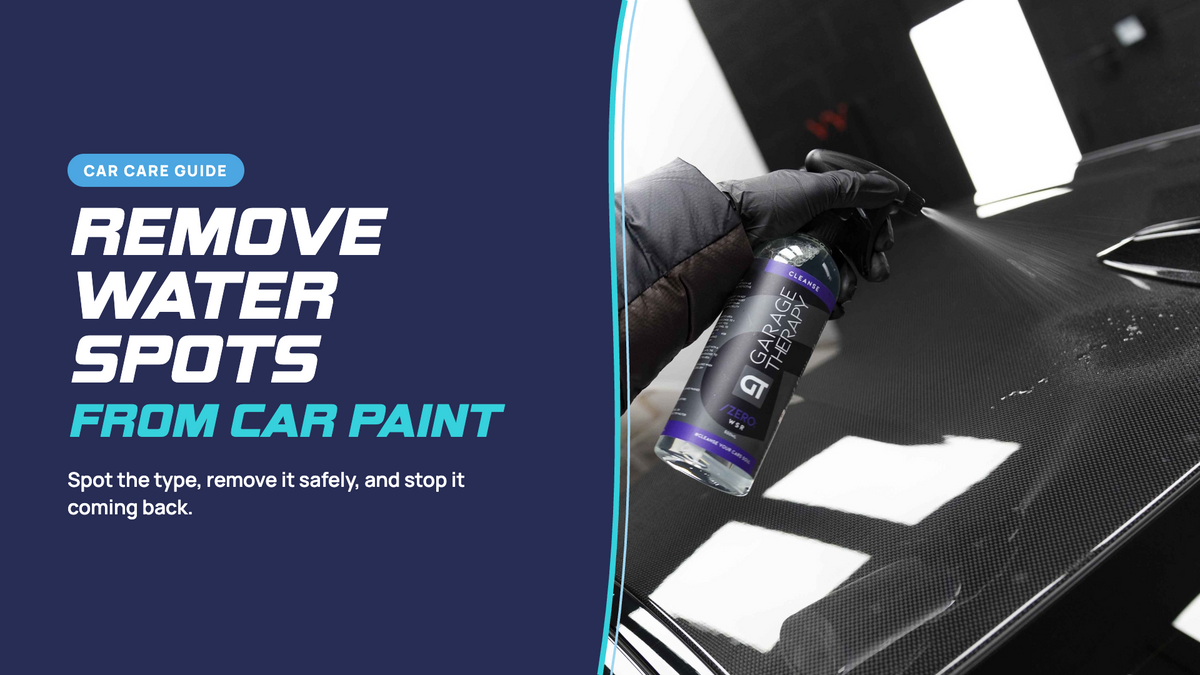
You've just finished washing your car, it looks great, and then the sun comes out. Suddenly the paint is covered in little white rings and dots. Those are water spots, and they're one of the most common questions we get asked in the shop.
The good news is that most water spots come off easily, if you use the right method. This guide covers what water spots are, how to tell which type you've got, how to remove them safely, and how to stop them coming back.
What are water spots?
Water spots are the minerals left behind when water evaporates on your paint. Tap water and rainwater both contain dissolved minerals like calcium and magnesium. When a droplet dries, the water disappears but the minerals don't. They're left on the surface as a white or grey ring.
They're most common when:
- you wash your car in direct sunlight or on a warm panel
- you leave the car to air dry instead of drying it
- you live in a hard water area
- rain or sprinkler water dries on the car
- water drips from mirrors, trims and door shuts after a wash

How to tell: wash and dry the area, then look at it under a torch or in the sun. If the spot wipes off, it was surface. If it shifts with a water spot remover, it was bonded. If you can still see the ring after that, it's etched.
How to remove water spots: step by step
Step 1: wash and dry the car properly
Always start with a clean car, so you're not rubbing dirt into the paint while you work on the spots. Use a pH-neutral shampoo such as Gyeon Q2M Bathe, then dry the car straight away with a plush drying towel like the MCC Signature Double Twist Drying Towel or the Duel Triple Twisted Loop Drying Towel.
Work in the shade, on a cool panel. Water spot removers dry quickly in the sun, and that can leave you with more marks than you started with.
Step 2: try a detailing spray on light spots
For fresh, surface spots, start gentle. Koch Chemie Finish Spray Exterior (FSE) is designed to remove limescale marks while adding gloss. Spray it on, then buff off with a clean microfibre.
Step 3: use a dedicated water spot remover
If the spots are still there, it's time for a water spot remover. These use mild acids to dissolve the mineral deposits without harming your paint.
- Gyeon Q2M WaterSpot: thick, easy to control, and designed to be safe on paintwork.
- Garage Therapy /ZERO: WSR Water Spot Remover: an acid blend for limescale and mineral deposits, suitable for paint, glass, wheels and trim.
How to use them:
- Work one panel at a time.
- Spray onto a clean microfibre, or lightly onto the panel.
- Wipe over the spots with light pressure.
- Buff dry with a fresh microfibre straight away. Don't let the product dry on the surface.
- Repeat on stubborn areas, then rinse or wipe the panel down.
Got a ceramic coating? Check the label first. Not every water spot remover is safe on every coating, and some can reduce a coating's water-beading for a while.
Step 4: check your work
Wipe the area with a panel prep or inspection spray (see our inspection sprays) to remove any leftover residue. Then check it under a torch. If you can still see rings, the spots are etched.
Step 5: polish out etched spots
Etched water spots are in the paint itself, so the only way to remove them is to level the clear coat with a polish.
- By machine: a dual action polisher like the Chemical Guys TORQX or Rupes Bigfoot LHR15 Mark V is the safest way for beginners. Pair it with a one-step polish such as Performance PPL Go Home or Rupes Uno Protect.
- Small areas: Rupes 40mm or 70mm spot pads let you target just the marked area.
- Deeper etching: you may need a stronger compound like Rupes DA Fine, followed by a finishing polish.
Not confident with a polisher? MCC Detailing can do it for you in our Newcastle studio.
Step 6: protect the paint
Once the spots are gone, add protection. It makes the paint easier to clean, and fresh spots wipe off more easily. For a quick, easy option, try Gyeon Q2M Wet Coat, which you spray on and rinse off. For longer protection, try Performance PPL Forcefield or Gyeon Q2 CanCoat EVO.
How to stop water spots coming back
- Wash in the shade, not in direct sun. Early morning or evening is best.
- Work panel by panel, and don't let shampoo or rinse water dry on the car.
- Dry straight away with a plush drying towel. Never leave the car to air dry.
- Blow out mirrors, badges and trims, or dry them last, so they don't drip onto clean paint.
- Use filtered water. If you live in a hard water area, a deioniser removes the minerals completely. Read more in our DI resin vessel guide.
- Keep your protection topped up. Protected paint sheds water faster and gives minerals less chance to stick.
- Dry the car after heavy rain if you can, especially if it's going to be sunny afterwards.
FAQs
Can I use vinegar to remove water spots? Diluted white vinegar can shift light spots, but it's hard to control and can affect waxes, coatings and trim. A dedicated water spot remover is safer and works faster.
Are water spots permanent? Most aren't. Surface and bonded spots come off with the right product. Etched spots need polishing, but in most cases they can be removed.
Does a ceramic coating stop water spots? No. A coating makes water bead, and those beads can still dry into spots. But spots on a coated car are usually much easier to remove, and the coating protects the paint from etching.
Can I use the same products on glass? Yes. Garage Therapy WSR is suitable for glass, and Gyeon WaterSpot can be used on it too. Don't leave either product sitting on glass for long.
Need a hand?
Not sure which type of water spots you've got, or which product to use? Pop into the shop at 2 Plummer Street, Newcastle, and we'll point you in the right direction. If you'd rather leave it to the experts, MCC Detailing can remove water spots and protect your paint for you.
Related reads: Best Water Spot Removal Products · The Spotless Water Solution: DI Resin Vessels