
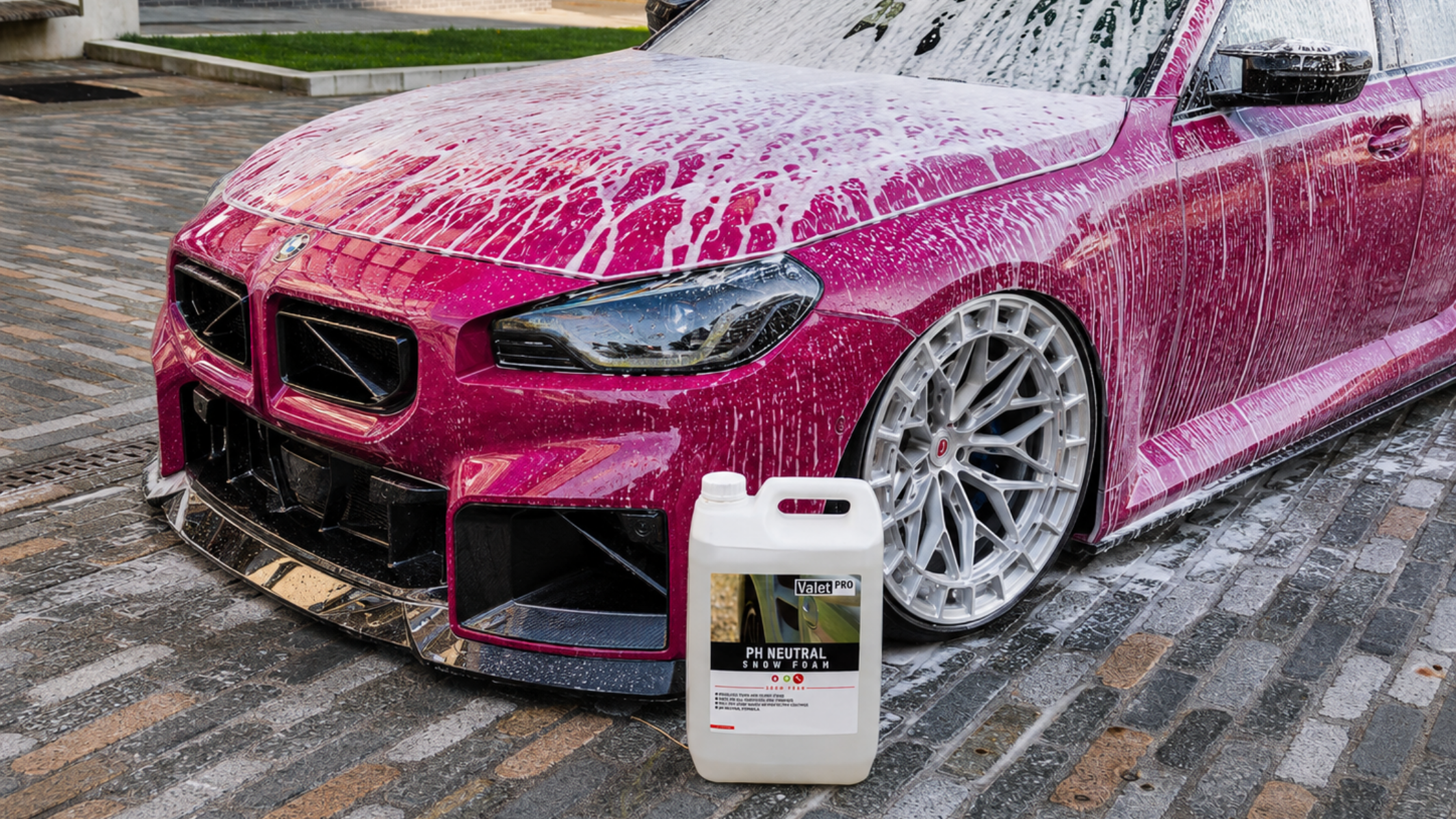
What Should You Actually Use?
If you've spent any time shopping for detailing products, you've probably seen terms such as "pH neutral", "alkaline cleaner" and "acidic wheel cleaner". They're frequently mentioned on labels and product descriptions—but what do they actually mean, and does pH really matter when cleaning your car?
The short answer is yes, but perhaps not for the reason many people assume.
Understanding the basic chemistry behind detailing products can help you choose a cleaner suited to the contamination you're trying to remove. It can also help you avoid the common mistake of assuming that the strongest chemical is automatically the best one.
Here's what car enthusiasts need to know about pH and how it applies to a practical detailing routine.
What Does pH Mean?
pH is a scale used to describe how acidic or alkaline an aqueous solution is.
A value around 7 is considered neutral. Values below 7 are acidic, while values above 7 are alkaline.
That doesn't mean every pH-neutral product is automatically gentle or every alkaline product is dangerously aggressive. Cleaning performance depends on the complete formulation, concentration, dwell time and the surface on which the product is being used.
Nevertheless, pH gives you useful information about the type of chemistry involved.
Why Are So Many Car Shampoos pH Neutral?
Maintenance shampoos are designed to be used frequently, often on vehicles that already have wax, sealant or ceramic protection applied.
The goal isn't to strip everything from the surface. It's to remove everyday contamination while leaving the underlying protection largely undisturbed.
This is why pH-neutral shampoos are so popular for routine contact washing.
A product such as JennyChem Cherry Bomb Shampoo can form part of this regular maintenance stage, providing cleaning and lubrication without requiring unnecessarily aggressive chemistry for a lightly contaminated vehicle.
When Does an Alkaline Cleaner Make Sense?
Not every vehicle arrives at wash day with a light layer of dust.
Winter traffic film, oily road grime, insect residue and heavily soiled lower panels can require considerably greater cleaning power.
Alkaline cleaners are particularly useful against many forms of oily and organic contamination, which is why stronger pre-wash products often use alkaline chemistry.
Used correctly, they can remove a substantial amount of contamination before physical washing begins.
This can actually contribute to a safer wash because there's less dirt left for the wash mitt to encounter.
Stronger Doesn't Automatically Mean Better
If a strong cleaner removes dirt quickly, it might seem logical to use it for every wash.
That's rarely necessary.
Good detailing is about matching the chemical to the job. A lightly dusty, well-protected vehicle generally doesn't require the same cleaning strength as a car covered in weeks of winter road film.
Repeatedly using unnecessarily aggressive chemistry can also affect some waxes, sealants and sensitive materials.
A better strategy is to reserve stronger products for situations where their additional cleaning ability is actually needed.
What About Acidic Cleaners?
Acidic chemistry also has useful applications within detailing, particularly when dealing with certain mineral deposits and wheel contamination.
However, specialist products should always be used according to their manufacturer's instructions and with consideration for the surface being treated.
Not every wheel finish, trim material or previously repaired surface responds identically to strong chemicals.
If you're unsure about compatibility, test an inconspicuous area first and never allow a product to dry on the surface.
Iron Fallout Removers Work Differently
One area that often causes confusion is iron contamination.
Those tiny particles of brake dust and industrial fallout that embed themselves into paint and wheels aren't always best addressed by simply choosing a stronger shampoo.
Dedicated fallout removers are formulated to chemically react with ferrous contamination, helping dissolve the embedded particles so they can be rinsed away with less mechanical agitation.
This is an excellent example of why choosing chemistry specifically suited to the contamination is more effective than simply reaching for the strongest general-purpose cleaner available.
Why Dwell Time Matters
Cleaning products need time to work.
Spraying a pre-cleaner onto a dirty panel and immediately rinsing it away may dramatically reduce its effectiveness.
Allowing appropriate dwell time gives the chemistry an opportunity to loosen and break down contamination.
However, dwell time should never become drying time.
Always follow the product directions, work out of strong sunlight where possible and avoid allowing chemicals to dry onto the vehicle.
Dilution Is Part of the Equation
Many concentrated detailing products can be diluted differently depending on the severity of contamination.
This is useful because you don't always need maximum strength.
A lighter dilution may be suitable for regular maintenance, while heavier contamination might call for a stronger mixture where the manufacturer allows it.
Guessing ratios isn't the best approach. Follow the product's recommended dilution guidance and use suitable measuring equipment when accuracy matters.
pH and Ceramic-Coated Vehicles
Ceramic coatings are designed to provide durable chemical resistance, but coated cars still need sensible maintenance.
Over time, traffic film, minerals and other contamination can accumulate over the coating and reduce its apparent hydrophobic performance.
This doesn't necessarily mean the coating has disappeared.
A deeper maintenance product such as GYEON Q²M Restart Wash can help remove accumulated contamination and restore the behaviour of the underlying coating.
This is why alternating between gentle routine maintenance and occasional deeper cleaning can be more effective than using the exact same shampoo for every situation.
Use the Least Aggressive Effective Method
A useful principle throughout detailing is to start with the least aggressive method likely to achieve the result you need.
If ordinary maintenance shampoo removes the contamination, there's little reason to escalate to stronger chemistry.
If it doesn't, move to a product specifically formulated for the problem you're facing.
The same principle applies to polishing, wheel cleaning and interior detailing. Controlled escalation is generally safer than starting aggressively.
Don't Mix Detailing Chemicals
Different products shouldn't be mixed together in an attempt to create a stronger homemade cleaner unless the manufacturer explicitly states that they are designed to be combined.
Detailing chemicals are formulated as complete products. Mixing them can alter their behaviour, reduce performance or create unwanted reactions.
Use each product as intended, follow the label instructions and rinse thoroughly where required.
Final Thoughts
Understanding pH makes choosing car cleaning products considerably easier, but the number on the scale shouldn't be viewed in isolation.
pH-neutral shampoos are excellent for regular maintenance. Stronger alkaline cleaners can be invaluable when tackling heavier road grime, while specialist chemistry is often the better solution for contamination such as iron fallout or mineral deposits.
The objective isn't to find the strongest product. It's to find the right product for the surface, contamination and job in front of you.
Explore the wider washing and detailing range at My Car Cleaning to build a cleaning system that gives you the right level of cleaning power for everything from weekly maintenance to deeper decontamination.